

Introduction
Choosing between a neon tetra vs cardinal tetra can be surprisingly difficult. Both fish have the famous electric-blue stripe and bright red coloration that make them stand out in freshwater aquariums. They are peaceful, active, and naturally social, but they are not the same species.
The neon tetra, Paracheirodon innesi, is slightly smaller, while the cardinal tetra, Paracheirodon axelrodi, is larger and has red coloration extending much farther along its body. Their care requirements overlap considerably, yet differences in water conditions, temperature preferences, sourcing, size, and schooling behavior can influence which fish fits your aquarium.
Understanding the neon tetra vs cardinal tetra difference before purchasing your fish helps you build a healthier and more natural-looking aquarium. Both species do best in mature, stable tanks with plants, gentle filtration, appropriate water chemistry, and enough members of their own species to feel secure.
Neon Tetra vs Cardinal Tetra: The Main Difference
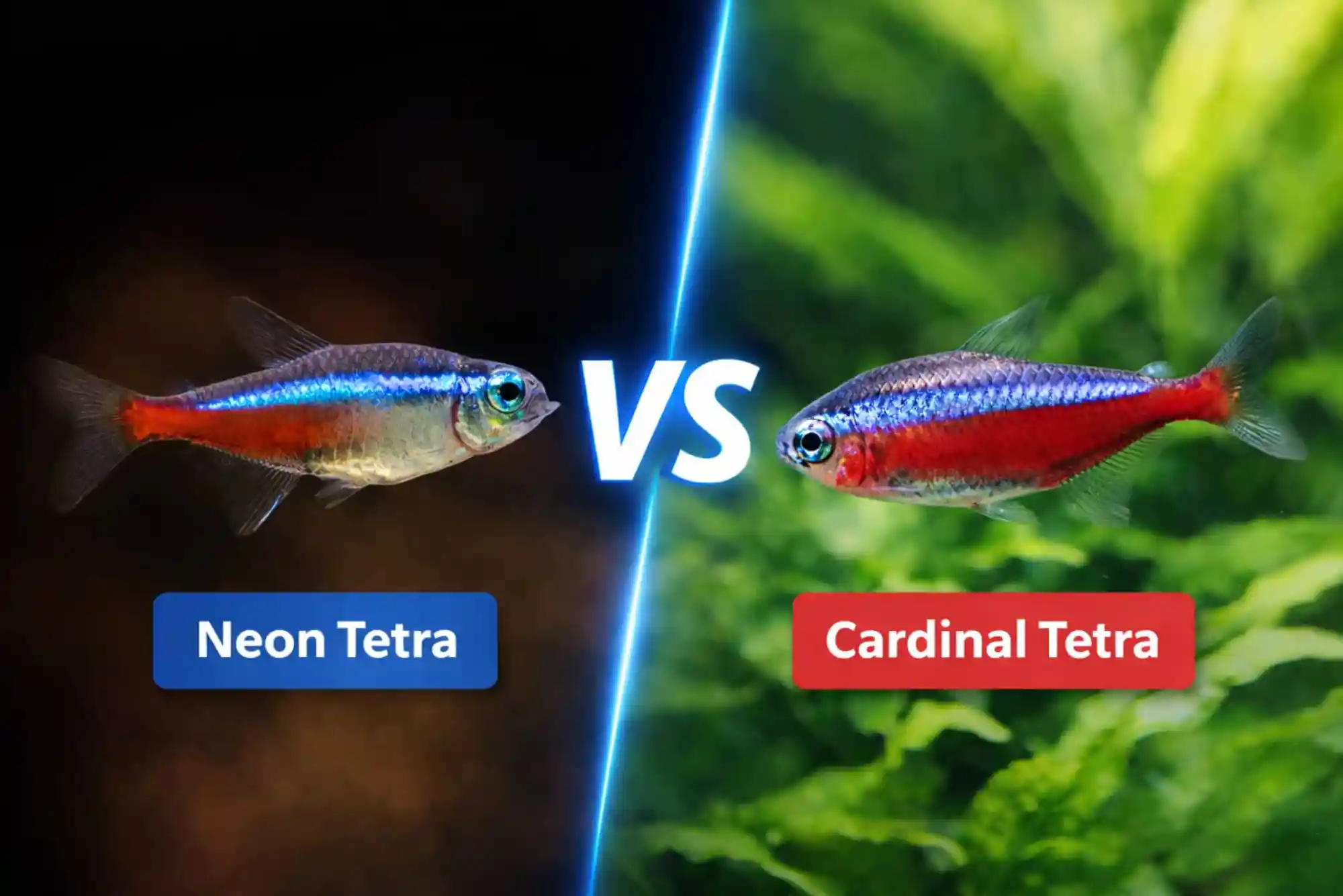
The easiest way to distinguish these fish is by looking at the red stripe.
A neon tetra has an iridescent blue stripe running along its upper body and a red stripe that begins around the middle of the body and continues toward the tail. The front portion of its lower body remains mostly silvery.
A cardinal tetra has a similar blue stripe, but its red coloration extends almost from the head all the way to the tail. This gives the cardinal tetra a noticeably more continuous red-and-blue appearance.


Cardinals also grow slightly larger. Aquarium Co-Op describes captive cardinal tetras reaching about 4 cm, while neon tetras are closer to 3 cm.
There is also a difference in how the fish are commonly sourced. Neon tetras are widely captive-bred, making them inexpensive and readily available. Cardinal tetras are still commonly associated with wild collection, although captive-raised specimens are increasingly available.
Appearance and Color Differences
How to Identify a Neon Tetra
The neon tetra has a silver body with a brilliant blue horizontal stripe. Its red stripe covers approximately the rear half of the body.
Under suitable aquarium lighting, the blue stripe can appear almost luminous. Dark substrate, aquatic plants, and subdued lighting can make the colors particularly noticeable.
Because neon tetras are smaller, their coloration often produces a delicate shimmering effect when a large group moves together.
How to Identify a Cardinal Tetra
The cardinal tetra has a similar blue stripe but much more extensive red coloration. The red runs along almost the entire lower body, making the fish appear more intensely colored.
This distinction is the quickest visual test when comparing the neon tetra vs cardinal tetra.
Cardinals also tend to have slightly more visual presence because they are larger. Their continuous red stripe can look especially dramatic against dark substrate, driftwood, and green plants.
Neon Tetra vs Cardinal Tetra: Water Requirements
Both species come from tropical South American environments and generally appreciate clean, stable water. However, their natural environments and commercial sourcing mean that individual fish can respond differently to aquarium conditions.
Neon tetras are commonly kept around 22–26°C, while cardinal tetras are generally maintained somewhat warmer, around 24–28°C depending on the source and aquarium setup. The important point is not to chase an exact number at the expense of stability. Sudden temperature or chemistry changes can stress either species.
Cardinal tetras are particularly associated with soft, acidic blackwater environments. Their native habitats include waterways influenced by tannins, leaf litter, vegetation, and low mineral content.
For either species, test your aquarium rather than relying solely on a general internet range. A stable, fully cycled aquarium is more important than trying to force water chemistry into an extreme number.
Tank Size and Aquarium Setup
A properly designed aquarium makes a major difference to tetra behavior.
Although small groups can technically occupy relatively small aquariums, a longer tank is often more useful than a tall tank because these fish spend much of their time moving through the middle portion of the water column.
A 20-gallon aquarium provides substantially more swimming room and water stability than a very small aquarium. It also gives you more flexibility when maintaining a proper school and selecting peaceful tank mates.
Dense planting around the sides and rear of the aquarium creates security while leaving an open swimming area in the center. Driftwood, floating plants, and leaf litter can further create the shaded environment these fish naturally associate with.
Both species appreciate cover. Aquarium Co-Op specifically recommends plants because they provide hiding areas and help schooling fish feel secure.
Schooling Tips for Neon and Cardinal Tetras
Schooling is one of the main reasons people keep these fish.
Neither neon tetras nor cardinal tetras should be treated as solitary display fish. They are social schooling species, and their behavior is usually more confident and natural when kept with several members of their own species.
Six fish is commonly treated as a minimum starting point, but a larger group can produce more convincing schooling behavior. Aquarium Co-Op recommends approximately eight to ten cardinal tetras for a 15- to 20-gallon aquarium or larger.
For neon tetras, groups of six or more are also widely recommended, with larger groups often producing better social behavior.
The biggest mistake is buying only two or three because they are small. A tiny group can make the fish nervous and cause them to hide rather than swim confidently in the open.
A larger, appropriately stocked school can create the classic synchronized movement that makes these fish so appealing.
Why Tetras Sometimes Stop Schooling
It is normal for schooling fish to spread out when they feel comfortable. A common misconception is that they must remain perfectly synchronized every second.
In a calm aquarium, neon and cardinal tetras may spread out to explore, feed, or rest. When they perceive movement, shadows, or potential danger, they may regroup quickly.
If your tetras constantly hide, remain pale, gasp, or behave unusually, look beyond schooling behavior. Water quality, unsuitable tank mates, insufficient cover, recent transportation, and inadequate group size can all contribute to stress.
Healthy schooling does not mean the fish are permanently glued together. It means they have the confidence to interact naturally and regroup when necessary.
Can Neon Tetras and Cardinal Tetras Live Together?
Yes, neon tetras and cardinal tetras can live together when their environmental requirements are compatible.
They are peaceful relatives with similar body shapes, diets, and general behavior. A sufficiently spacious aquarium can house both species, provided the water parameters, temperature, filtration, and stocking level are appropriate.
However, mixing species does not automatically create one perfect school. Each species may still show stronger social behavior around its own kind. If you have enough space for only one proper group, maintaining a larger group of one species is often more sensible than splitting the available fish between two undersized groups.
The goal should be adequate numbers and swimming space rather than simply increasing the variety of fish.
Feeding Neon and Cardinal Tetras
Feeding requirements for the neon tetra vs cardinal tetra are quite similar.
Both species have small mouths, so food should be appropriately sized. Quality micro pellets, finely crushed flakes, and appropriately sized frozen foods can form part of a varied diet.
Small portions are preferable to large meals. Uneaten food decomposes quickly in a small aquarium and can contribute to deteriorating water quality.
Occasional frozen or live foods such as baby brine shrimp and daphnia can provide variety, while a quality staple food supplies everyday nutrition.
Watch the fish while feeding. If food sinks untouched or remains on the substrate, reduce the quantity. If the fish consume everything immediately and remain active afterward, the portion may be appropriate.
Tank Mates for Neon and Cardinal Tetras
Both species are peaceful community fish, but their small size means tank-mate selection matters.
Calm bottom-dwelling species such as Corydoras and kuhli loaches can work well because they use different areas of the aquarium. Peaceful small rasboras and other appropriately sized community fish may also be compatible.
The major concern is predation. Large fish can view small tetras as food, particularly once they reach adulthood.
Aggressive or persistent fin-nipping species are also poor companions. Even if they do not directly kill the tetras, constant chasing can create chronic stress.
Shrimp compatibility depends on the shrimp species and their life stage. Adult larger shrimp may coexist, while tiny shrimplets can potentially be eaten by opportunistic fish.
Neon Tetra vs Cardinal Tetra: Hardiness and Health
It is tempting to label one species universally “hardier,” but real-world results depend heavily on fish quality, transportation, quarantine, aquarium maturity, and water stability.
Neon tetras are extensively captive-bred, but commercially produced fish can vary in quality. Cardinal tetras are frequently wild-caught, meaning acclimation and transportation can be significant considerations.
Neither fish should be introduced into an immature aquarium.
A tank can look crystal clear while still having dangerous ammonia or nitrite levels. Before adding tetras, make sure the biological filtration is established and test the water regularly.
Quarantining new fish is also sensible because disease can enter an established aquarium through newly purchased livestock.
One concern among tetra keepers is neon tetra disease, caused by the microsporidian Pleistophora hyphessobryconis. Despite its common name, the disease is not limited to neon tetras; related species can also be affected. Prevention through careful sourcing and quarantine is therefore important.
Lighting, Plants, and Aquascaping
Your aquascape can dramatically influence how these fish look and behave.
A heavily planted aquarium with an open swimming zone is particularly effective. Tall plants toward the back create depth, while floating vegetation can soften the light.
Dark substrate can also increase the visual contrast of blue and red coloration.
Cardinal tetras are especially striking in blackwater-style aquariums containing driftwood, leaf litter, subdued lighting, and tannin-stained water. Neon tetras can also look excellent in planted community aquariums with slightly brighter conditions.
Avoid making the aquarium completely open. Small schooling fish generally benefit from areas where they can retreat when startled.
Neon Tetra vs Cardinal Tetra: Which Fits Your Aquarium?
Instead of asking which species is universally better, consider what your aquarium already provides.
A neon tetra may fit well if you want a smaller, widely available schooling fish and prefer the classic half-red, half-blue appearance.
A cardinal tetra may suit an aquarist who wants a slightly larger fish with a full-length red stripe and has a mature aquarium capable of maintaining suitable warm, soft-water conditions.
Budget can also matter. Neon tetras are generally more affordable and widely available, while cardinal tetras often cost more. Aquarium Co-Op similarly notes the higher price of cardinal tetras compared with neons.
The most important consideration is not the price of an individual fish. It is whether you can comfortably maintain an appropriately sized group in a stable aquarium.
Common Mistakes to Avoid
One of the most common mistakes is buying only a few tetras because the fish are small. Their social needs do not disappear because of their size.
Another mistake is adding them to a newly established aquarium simply because the water looks clean. Biological stability cannot be judged by appearance alone.
Overcrowding is another problem. A larger school can be beneficial, but only when the aquarium has enough swimming space, filtration, and maintenance capacity.
Finally, avoid choosing fish purely because they look attractive at the store. Consider adult size, water chemistry, temperature, tank mates, and the number of fish you can responsibly maintain.
FAQs
What is the difference between a neon tetra and a cardinal tetra?
The easiest difference is the red stripe. A neon tetra has red coloration mainly across the rear half of its body, while a cardinal tetra has red extending along almost the entire lower body. Cardinals are also slightly larger.
Can neon tetras and cardinal tetras live together?
Yes. They are peaceful relatives with broadly similar aquarium requirements and can share a suitable community aquarium. However, each species benefits from having an adequate group of its own kind rather than relying on the other species for social security.
How many neon tetras should be kept together?
At least six is a commonly recommended starting point, while larger groups can encourage more natural schooling behavior. The final number should always match the aquarium’s size, filtration, and other inhabitants.
How many cardinal tetras should be kept together?
Six is a reasonable minimum, while groups of eight to ten or more can provide better social interaction when the aquarium has enough space. Aquarium Co-Op recommends eight to ten cardinal tetras for a 15- to 20-gallon aquarium or larger.
Which is more colorful, neon tetra or cardinal tetra?
Color perception is subjective, but cardinal tetras generally appear more intensely red because their red stripe extends much farther along the body. Neon tetras have a shorter red stripe and a slightly smaller overall appearance.
Do neon and cardinal tetras need a heater?
In most tropical indoor aquariums, a reliable heater is useful for maintaining a stable temperature. Both species are tropical fish, and avoiding rapid temperature fluctuations is more important than chasing a single “perfect” number.
Are neon tetras or cardinal tetras better for beginners?
Neither should be placed into an uncycled or unstable aquarium. Neon tetras are widely available and commonly captive-bred, while cardinal tetras can require careful acclimation and suitable soft-water conditions. Your existing water chemistry and aquarium stability should guide the choice.
Why are my neon or cardinal tetras not schooling?
Some spreading out is completely normal. If the fish constantly hide, appear pale, or behave unusually, check water quality, group size, temperature, tank mates, and available cover. Stress can change normal schooling behavior.
The neon tetra vs cardinal tetra comparison comes down to more than a red stripe. Neon tetras are smaller and widely available, while cardinal tetras are slightly larger and display red coloration across almost the entire body. Both are peaceful schooling fish that can become spectacular centerpiece species in a planted community aquarium.
Whichever species you choose, focus on the fundamentals: a mature aquarium, stable water, suitable temperature, good filtration, appropriate food, peaceful tank mates, and a sufficiently large school.