
Introduction
Knowing how to lower ammonia in fish tanks naturally and quickly is one of the most important skills for any aquarium keeper. Ammonia is produced when fish release waste and when uneaten food, dead organisms, or decaying plant material break down. In a healthy, established aquarium, beneficial bacteria process this waste through the nitrogen cycle. When that biological system cannot keep up, ammonia begins to accumulate.
Even a small detectable ammonia reading deserves attention. The safest target for a healthy aquarium is 0 ppm ammonia. High ammonia can irritate and damage fish gills, cause stress, and become dangerous when exposure continues.
The good news is that you do not always need complicated products to correct an ammonia problem. A properly performed water change, reduced feeding, good oxygenation, healthy filter bacteria, and removal of waste can make a significant difference.
Why Ammonia Rises in a Fish Tank
Before learning how to lower ammonia in fish tanks, it helps to understand where the problem comes from.
Fish naturally produce ammonia through waste and their gills. Uneaten food creates another source as it decomposes. Dead fish, snails, insects, rotting plants, and other organic material can also release ammonia into the water. Overstocking makes the problem worse because more fish create more waste for the same biological filter to process.
New aquariums are especially vulnerable because they may not yet have enough nitrifying bacteria. These microorganisms normally convert ammonia into nitrite and eventually nitrate. Until the biological filter becomes established, waste can accumulate much faster than bacteria can process it.


An established aquarium can also suddenly develop ammonia problems. Cleaning or replacing too much filter media, a prolonged filter failure, adding many fish at once, excessive feeding, or certain medications can disrupt the biological balance.
How to Lower Ammonia in Fish Tanks Quickly
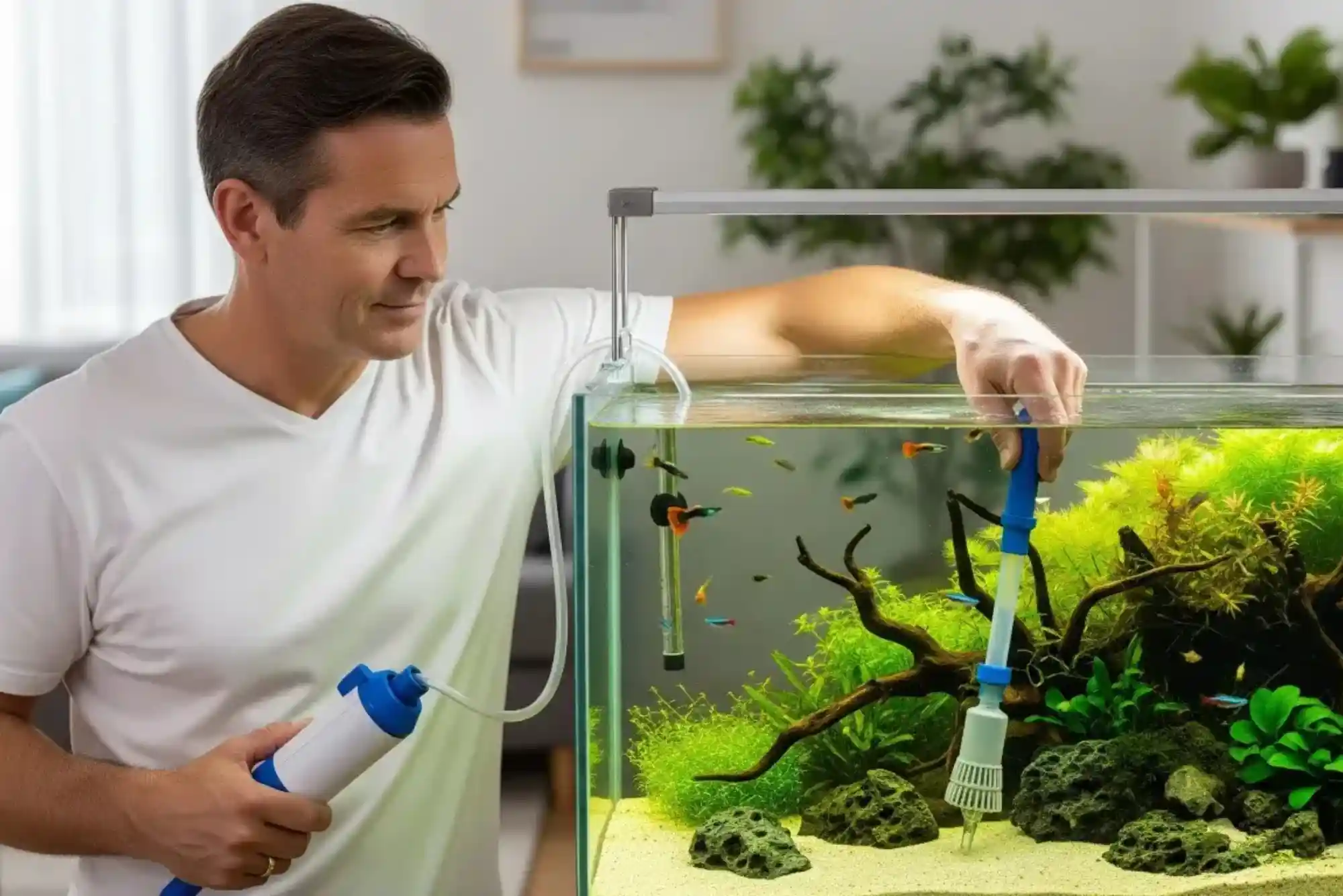
If your test kit shows detectable ammonia, do not wait for the tank to correct itself. The quickest natural method is dilution through a partial water change.
A 25% to 50% water change can immediately reduce the concentration of ammonia, provided the replacement water does not introduce additional ammonia. A 50% change theoretically cuts the concentration roughly in half.
Use water treated with an appropriate dechlorinator, and try to keep its temperature reasonably close to the aquarium water. Sudden changes in temperature or chemistry can create additional stress for fish that are already dealing with poor water quality.
For example, if an aquarium contains approximately 1 ppm ammonia and half of its water is replaced with ammonia-free water, the concentration can drop to roughly 0.5 ppm. A second appropriately timed water change can reduce it further.
The exact amount and frequency depend on the ammonia reading, fish species, tank conditions, and water chemistry. If fish are gasping, lying unusually still, or showing obvious distress, treat the situation as urgent.
Stop Feeding Temporarily
One of the simplest ways to lower ammonia in fish tanks is to reduce the amount of new waste entering the system.
During an ammonia spike, temporarily reducing or pausing feeding can help prevent additional organic waste from accumulating. Any food that remains uneaten eventually decomposes and contributes to the nutrient load.
Once ammonia has returned to zero and the fish are behaving normally, restart feeding with small portions. Give only what the fish can reasonably consume rather than adding extra food because the fish appear interested.
Long-term overfeeding is a common cause of poor aquarium water quality. Feeding less does not mean starving healthy fish. It means controlling the amount of waste the aquarium’s biological system must handle.
Remove the Source of Ammonia
A water change solves the immediate concentration problem, but it does not necessarily remove the reason ammonia appeared.
Inspect the aquarium carefully. Look underneath decorations, behind rocks, around plants, and inside caves for a dead fish or other decomposing material. Remove uneaten food and heavily decaying plant matter as well.
If you recently added several fish, the aquarium may simply have received a larger biological load than its bacterial population can process.
The same principle applies to feeding. If food consistently remains on the substrate after feeding, reduce the portion rather than allowing leftovers to decay.
Finding the source is essential because otherwise ammonia may fall after a water change and then begin climbing again.
Protect Your Beneficial Bacteria
Beneficial bacteria are the foundation of natural ammonia control.
These microorganisms colonize surfaces throughout the aquarium, particularly biological filter media. They convert toxic ammonia into nitrite and then help convert nitrite into nitrate. This biological filtration is why a mature aquarium can process fish waste without continuously developing dangerous ammonia concentrations.
One common mistake is cleaning filter media under untreated tap water. Depending on the water supply, chlorine or chloramine can damage the bacterial population that your aquarium depends upon.
Instead, when maintenance requires cleaning, gently rinse or squeeze appropriate filter media using removed aquarium water. Avoid aggressively scrubbing biological media until it looks brand new.
You also generally should not replace all biological filter media at once unless there is a specific reason to do so. Preserving established media helps maintain the bacterial colony.
Increase Oxygen and Water Movement
Good oxygenation supports both fish and the bacteria involved in biological filtration.
Nitrifying bacteria require oxygen to efficiently process ammonia and nitrite. Low dissolved oxygen can therefore reduce the efficiency of biological treatment. Research from the University of Florida notes that insufficient oxygen can limit nitrification and recommends monitoring oxygen conditions in aquatic systems.
During an ammonia problem, make sure the filter is operating correctly and that there is adequate movement at the water surface. An air stone can also increase surface agitation and gas exchange.
This does not physically remove ammonia from the aquarium. Instead, it supports the biological system that ultimately processes it and can improve conditions for stressed fish.
Use Live Plants as Part of Natural Ammonia Control
Aquatic plants can contribute to healthier aquarium water by taking up nitrogen compounds and using them for growth. A well-planted aquarium can therefore provide additional biological support.
However, plants should not be treated as an emergency substitute for a water change when ammonia is elevated.
A sudden ammonia spike can overwhelm the aquarium’s natural systems faster than plants can respond. Decaying plants can also become another source of organic waste.
Healthy, actively growing plants are useful as part of a balanced aquarium ecosystem, but the fundamentals remain the same: appropriate stocking, good filtration, controlled feeding, and regular maintenance.
Understand the Nitrogen Cycle
The nitrogen cycle explains why ammonia eventually disappears from a mature aquarium.
Fish waste and decomposing organic material produce ammonia. Beneficial bacteria then convert ammonia into nitrite. Another group of bacteria converts nitrite into nitrate, which is considerably less toxic at normal aquarium concentrations.
This process does not happen instantly in a new aquarium. A newly established tank may require several weeks for its bacterial population to develop sufficiently. One current aquarium cycling guide places a typical fishless cycle around four to six weeks, although individual aquariums can vary.
If you repeatedly lower ammonia with water changes but never allow the biological filter to establish, the problem can continue indefinitely.
The goal is therefore not simply to remove today’s ammonia. The goal is to create an aquarium capable of processing tomorrow’s waste.
Can Beneficial Bacteria Help Lower Ammonia?
Yes. Beneficial bacteria are the long-term biological solution to ammonia accumulation.
If an aquarium has recently been established or its biological filtration has been disrupted, adding an appropriate bacterial culture may help establish or restore biological filtration. Mature filter media from a healthy, disease-free established aquarium can also introduce an existing bacterial population.
However, bottled bacteria should not be viewed as an instant replacement for water changes. Results can vary depending on the product, storage conditions, aquarium temperature, water chemistry, and the existing bacterial population.
When ammonia is already elevated, continue testing and controlling the water rather than assuming that adding bacteria has immediately solved the problem.
Check Nitrite Too
A common mistake is to focus entirely on ammonia.
As beneficial bacteria begin processing ammonia, nitrite can rise. Nitrite is also harmful to fish, so a falling ammonia reading does not necessarily mean the aquarium is safe.
During an active ammonia problem, test both ammonia and nitrite regularly. Continue monitoring until both remain at zero and the aquarium’s biological filtration is stable.
This is particularly important in newly established aquariums, where ammonia and nitrite can fluctuate as different bacterial populations develop.
Avoid Sudden pH Changes
It may be tempting to change the aquarium’s pH simply because ammonia is present. That can create another problem.
Ammonia toxicity is influenced by pH and temperature, but making sudden chemistry changes can stress fish and destabilize the aquarium further. The practical approach is to address the source of ammonia, dilute contaminated water when necessary, maintain stable conditions, and allow biological filtration to do its job.
Do not chase a particular pH number without considering the needs of the species in your aquarium.
Stable, appropriate water chemistry is generally more useful than repeatedly making dramatic adjustments.
How to Prevent Ammonia From Coming Back
The best way to lower ammonia in fish tanks naturally is to prevent excessive ammonia production in the first place.
Feed carefully and remove uneaten food. Keep stocking levels appropriate for the aquarium and filtration system. Add new fish gradually rather than suddenly increasing the biological load.
Maintain your filter without destroying its biological media. Make sure the filter has adequate flow and remains operational.
Regularly inspect the aquarium for dead fish, trapped food, rotting plant material, and other decomposing matter.
Testing is also important. A settled aquarium may need less frequent testing than a brand-new tank, but ammonia should be checked whenever fish behave unusually or the aquarium experiences a major change.
If ammonia repeatedly appears in an established tank, investigate the cause rather than simply performing water changes over and over.
Natural Methods vs. Quick Emergency Methods
There is an important difference between naturally controlling ammonia and temporarily detoxifying it.
Water changes physically dilute and remove ammonia from the aquarium. Reducing feeding prevents additional waste from entering the system. Beneficial bacteria process ammonia biologically. Plants can contribute to nutrient uptake. Good filtration and oxygenation support the natural process.
Commercial ammonia-binding or detoxifying products can sometimes provide additional short-term protection, but they should not be confused with physically removing the ammonia or fixing an immature biological filter. Some products temporarily change ammonia into a less toxic form, while standard test kits may still detect total ammonia afterward.
For a naturally managed aquarium, the foundation should remain biological filtration, sensible stocking, controlled feeding, and regular water maintenance.
What If Ammonia Is Still High After a Water Change?
If ammonia remains elevated after a partial water change, test the water again and investigate the source.
First, confirm that the replacement water itself is not contributing ammonia. This can matter in areas where municipal water uses chloramine, because chloramine contains ammonia chemically bonded with chlorine. Untreated tap water can therefore complicate an aquarium ammonia problem.
Next, inspect the filter and aquarium carefully. Check for dead livestock, excessive food, clogged filtration, recent filter-media replacement, or a sudden increase in fish numbers.
Continue appropriate partial water changes while monitoring both ammonia and nitrite. If fish are showing severe distress, seek advice from an experienced aquatic professional or veterinarian.
Build an Aquarium That Controls Ammonia Naturally
Learning how to lower ammonia in fish tanks is really about understanding the aquarium as a living biological system. Water changes provide the fastest immediate relief, while beneficial bacteria provide the long-term solution.
Keep feeding controlled, avoid overstocking, protect biological filter media, maintain good oxygenation, remove decomposing waste, and test ammonia and nitrite whenever something changes. Most importantly, do not treat a zero ammonia reading as the end of the process. A stable aquarium is one where the biological filter continually processes waste before ammonia can accumulate.
FAQs
How do I lower ammonia in my fish tank quickly?
The fastest practical method is a partial water change using properly treated, temperature-appropriate water. A 25% to 50% change can substantially dilute ammonia. At the same time, stop or reduce feeding temporarily, remove decaying material, ensure the filter is running, and increase oxygenation if needed.
How long does it take to lower ammonia in a fish tank?
A water change can reduce ammonia immediately through dilution, but keeping ammonia at zero takes longer if the aquarium’s biological filtration is immature or damaged. A mature biological filter can process ammonia continuously, while a new aquarium may take several weeks to establish a strong nitrogen cycle.
What causes high ammonia in an aquarium?
Common causes include overfeeding, excessive fish stocking, an uncycled aquarium, dead fish or other decomposing material, and disruption of beneficial bacteria. Filter problems and untreated tap water containing chloramine can also contribute to elevated readings.
Is 0.25 ppm ammonia safe for fish?
The practical target for aquarium ammonia is zero. A detectable reading means the biological system is not completely keeping up with the ammonia load. Treat the reading seriously, especially if fish are showing signs of stress, and investigate why ammonia is present.
Does adding plants lower ammonia in a fish tank?
Healthy aquatic plants can absorb nitrogen and contribute to overall nutrient management, but they should not be relied upon to correct a serious ammonia spike quickly. Water changes and functioning biological filtration remain more dependable responses.
Will changing the water remove ammonia?
Yes. A partial water change dilutes the ammonia concentration, provided the replacement water does not contain ammonia. A 50% water change can theoretically reduce the existing concentration by about half.
How do I lower ammonia naturally without chemicals?
Start with a partial water change using appropriately treated water, temporarily reduce feeding, remove decomposing waste, maintain healthy biological filter media, provide adequate oxygenation, and allow beneficial bacteria to establish. These methods address both the immediate concentration and the underlying biological process.